A plot of land can sit idle for years and produce nothing. The moment it is properly planned, verified, financed and built upon, it can begin to generate housing, business activity, rental income and long-term asset value. That is the real power of residential and commercial property development – turning land and ideas into places where people live, trade and build wealth.
Across Cameroon and the wider African market, that process matters more than ever. Population growth, urban expansion, infrastructure demand and rising investor interest are creating real opportunities. Yet opportunity alone is never enough. Strong development requires disciplined planning, legal clarity, market insight and execution that respects both present demand and future growth.
What residential and commercial property development really means
Residential and commercial property development is often treated as a simple matter of constructing buildings. In practice, it is a full value chain. It begins with land identification and verification, moves through acquisition, design, approvals, financing and construction, and continues into leasing, sales, asset management and long-term performance.
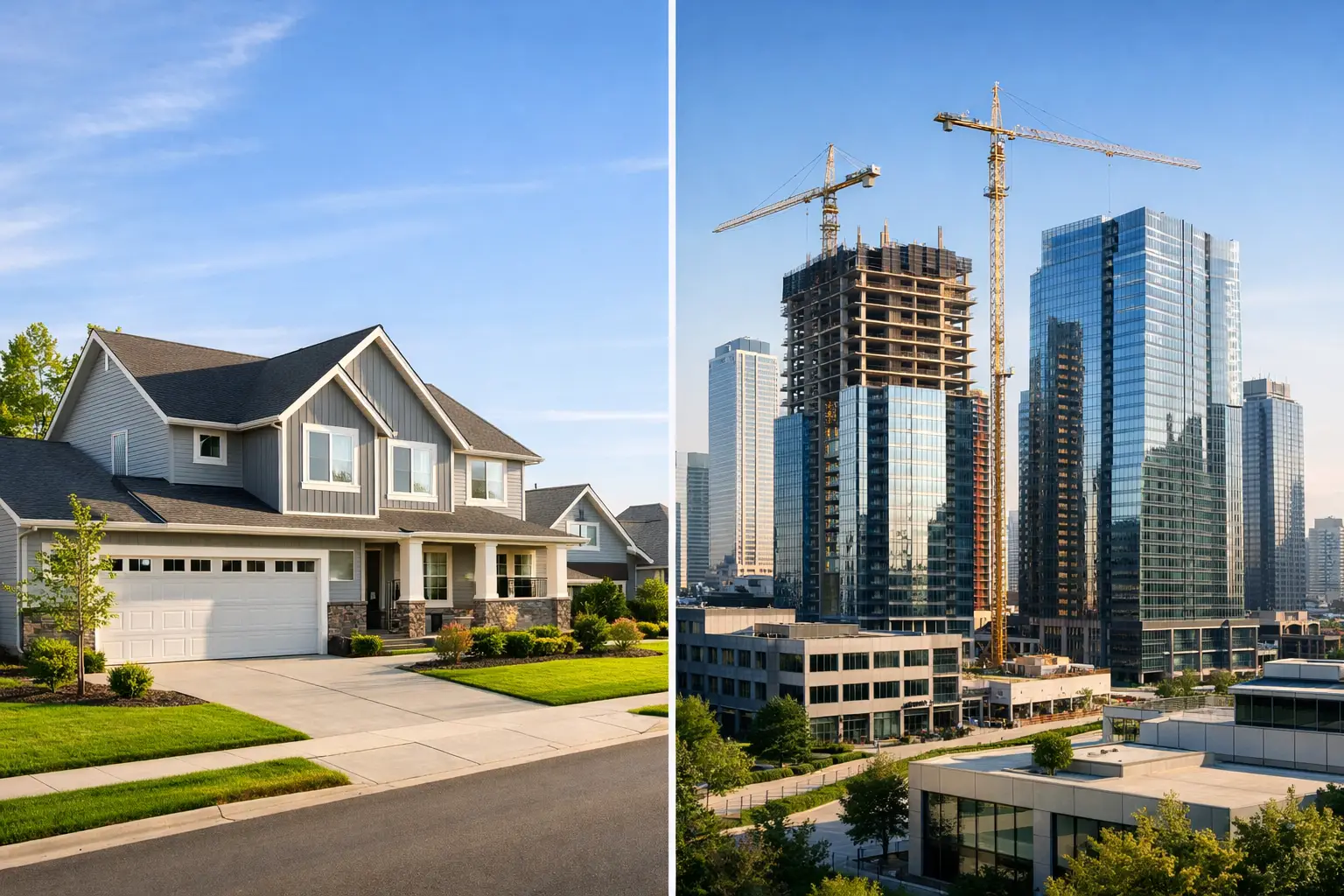
Residential development focuses on where people live. That may include single-family homes, blocks of flats, gated communities, mixed-income housing or serviced residences. Commercial development serves business use, such as office buildings, retail spaces, warehouses, hospitality projects and business parks.
The distinction matters because each asset class responds to different market signals. A residential scheme may be driven by household formation, affordability and access to schools or transport. A commercial project may depend more on footfall, tenant demand, logistics access, infrastructure quality and local business activity. The smartest developers understand that these are not interchangeable markets, even when they sit on neighbouring parcels of land.
Why residential and commercial property development matters in African markets
Real estate development is not only about buildings. It is about economic structure. Well-executed projects create jobs during surveying, planning, design and construction. They expand municipal tax bases, stimulate local commerce and improve the usefulness of land that may previously have been underutilised.
In many African cities, the need is immediate. Urban populations are rising faster than formal housing supply. Commercial corridors are expanding around new roads, industrial activity and emerging city centres. This creates a dual demand: people need secure, well-planned places to live, and businesses need functional space from which to operate.
That is why development should be approached as a strategic act, not a speculative gamble. When projects are aligned with infrastructure, title clarity, local demand and planning realities, they can perform strongly over time. When those fundamentals are ignored, investors often discover too late that a promising site has hidden legal, technical or commercial weaknesses.
The first decision is not construction – it is land quality
Many development problems begin long before the first foundation is laid. A site may look attractive because of price or location, but if ownership is disputed, boundaries are unclear or certification is incomplete, the project is already exposed. In markets where documentation quality can vary, land due diligence is not optional.
Serious developers assess title validity, survey accuracy, access routes, zoning compatibility, topography, soil condition and surrounding land use before they commit capital. A cheap plot in the wrong location, or with unresolved legal questions, can become far more expensive than a premium plot with clear documentation and strong growth prospects.
This is where professional support makes a measurable difference. A credible end-to-end partner can help buyers and investors move beyond surface-level attraction and focus on development viability. That kind of discipline is one reason firms such as Crown Homes Holdings continue to earn trust in a market where confidence is built on proof, not promises.
Residential development: demand is strong, but so is the need for precision
Housing demand across growing urban areas is undeniable, but not every residential project succeeds. The central question is not whether people need homes. It is whether the proposed product matches what the market can absorb.
A high-end gated estate may perform well in one corridor and struggle in another where middle-income buyers dominate. A block of flats may attract investors seeking rental yield, but if parking, drainage, security and road access are weak, occupancy can suffer. Developers who assume demand without studying buyer profile, price tolerance and neighbourhood direction often produce stock that takes too long to move.
There is also a timing question. Residential developments can generate steady long-term value, yet they often require patience. Sales cycles may lengthen in uncertain economic periods, and build quality matters enormously because homeowners are not only buying space – they are buying trust, lifestyle and durability.
Commercial development: higher upside, sharper exposure
Commercial projects can be powerful wealth-building vehicles because they are tied to business activity and income generation. A well-positioned retail strip, office facility or warehouse development can produce strong rental performance and attract institutional interest.
But commercial property is less forgiving when the market is misunderstood. A beautifully finished office block in an oversupplied area may remain under-let. Retail space in the wrong location may never generate the traffic tenants need. Warehousing may look attractive, yet poor road connectivity can undermine the model.
In other words, commercial development can reward strategic vision, but it also magnifies mistakes. Tenant mix, accessibility, infrastructure support, service charges and maintenance standards all influence long-term performance. This is why feasibility studies are not bureaucratic exercises. They are the basis of commercial discipline.
The strongest projects balance vision with realism
Ambition is essential in property development, especially in growth markets where city expansion can create extraordinary upside. Yet ambition without structure leads to avoidable losses. The best developers combine a bold view of future demand with practical controls around cost, phasing and compliance.
Sometimes a mixed-use approach creates stronger resilience than a single-purpose project. In the right location, combining residential units with retail frontage or office support can diversify income and improve land efficiency. In other cases, keeping a project tightly focused produces better execution and clearer market positioning. It depends on the site, infrastructure, buyer profile and capital strength behind the scheme.
Developers should also be honest about scale. There is no prestige in overbuilding. A phased project that sells or leases well often outperforms a grand development launched without enough market depth. Sustainable growth comes from sequencing decisions carefully, not from chasing size for its own sake.
Financing, approvals and execution are where many projects are won or lost
Even strong concepts can stall if the financial structure is weak. Development finance must account for land cost, approvals, professional fees, materials, labour, contingency and holding periods. Too many projects are budgeted for ideal conditions, then destabilised by inflation, delays or scope changes.
Approvals matter just as much. Planning, land certification, surveying and compliance requirements can affect programme timelines and investment confidence. Skipping process may seem faster at the start, but it usually creates greater risk later, especially when the project reaches sales, leasing or exit stages.
Execution then becomes the final test. Design quality, contractor oversight, procurement discipline and technical supervision all shape the finished asset. A project does not create value because a building exists. It creates value when the building is functional, market-ready, compliant and capable of sustaining income or resale demand.
A strategic approach to property development
For investors, landowners and aspiring developers, the real question is not whether to pursue residential and commercial property development. It is how to pursue it with confidence. That means starting with verified land, understanding local demand, choosing the right asset class, securing the right professional team and aligning development goals with realistic timelines.
It also means recognising that every project involves trade-offs. Residential schemes may offer broader demand but slower turnover in some segments. Commercial developments may produce stronger yields but carry greater leasing risk. Prime locations offer visibility and pricing power, yet acquisition costs can compress margins. Emerging areas offer upside, but they require stronger conviction and patience.
The African real estate market is entering a more disciplined era. Buyers want legitimacy. Investors want evidence. Communities want developments that improve how people live and work. This is good news for serious operators. It rewards developers who bring not just capital, but structure, credibility and long-range thinking.
The next major opportunity in real estate will not belong only to those who own land. It will belong to those who can turn land into lasting value with clarity, precision and purpose.